For most of automotive history, the development of vehicle dynamics relied on a combination of physical testing, engineering intuition, and incremental refinement on proving grounds. Prototype cars were built, tested, adjusted, and tested again in an expensive and time-consuming loop that depended heavily on real-world conditions.
That process is no longer sufficient on its own. Today, a significant part of how cars are designed, tuned, and validated is happening in a space that does not physically exist: advanced driving simulators.
What began as tools for gaming and driver training has evolved into high-precision environments capable of modelling vehicle behaviour at a level that increasingly influences real-world automotive engineering.
From Entertainment to Engineering Tool
Driving simulators were once primarily associated with entertainment or basic training systems. Early versions could approximate vehicle handling, but they lacked the fidelity required for serious engineering applications.
That gap has narrowed dramatically.
Modern simulation platforms now integrate real-world physics models, tyre deformation data, suspension geometry, aerodynamics, and even environmental variables such as temperature and surface friction. Combined with high-performance computing, these systems can replicate driving scenarios that are difficult, dangerous, or expensive to reproduce in real life.
This shift has elevated simulators from supportive tools to core components of vehicle development pipelines.
Manufacturers now use them not only to visualise concepts but to actively refine suspension tuning, steering response, stability control systems, and even brake calibration before a physical prototype is fully built.
Why Simulation Matters More Than Ever
The increasing complexity of modern vehicles is one of the key drivers behind this shift. As cars become more electronically controlled and software-defined, the number of variables influencing driving behaviour has expanded significantly.
Electric vehicles, in particular, introduce new challenges. Instant torque delivery, battery weight distribution, regenerative braking systems, and thermal management all affect handling in ways that traditional combustion-engine models do not fully capture.
Simulators allow engineers to isolate and test these variables in controlled environments.
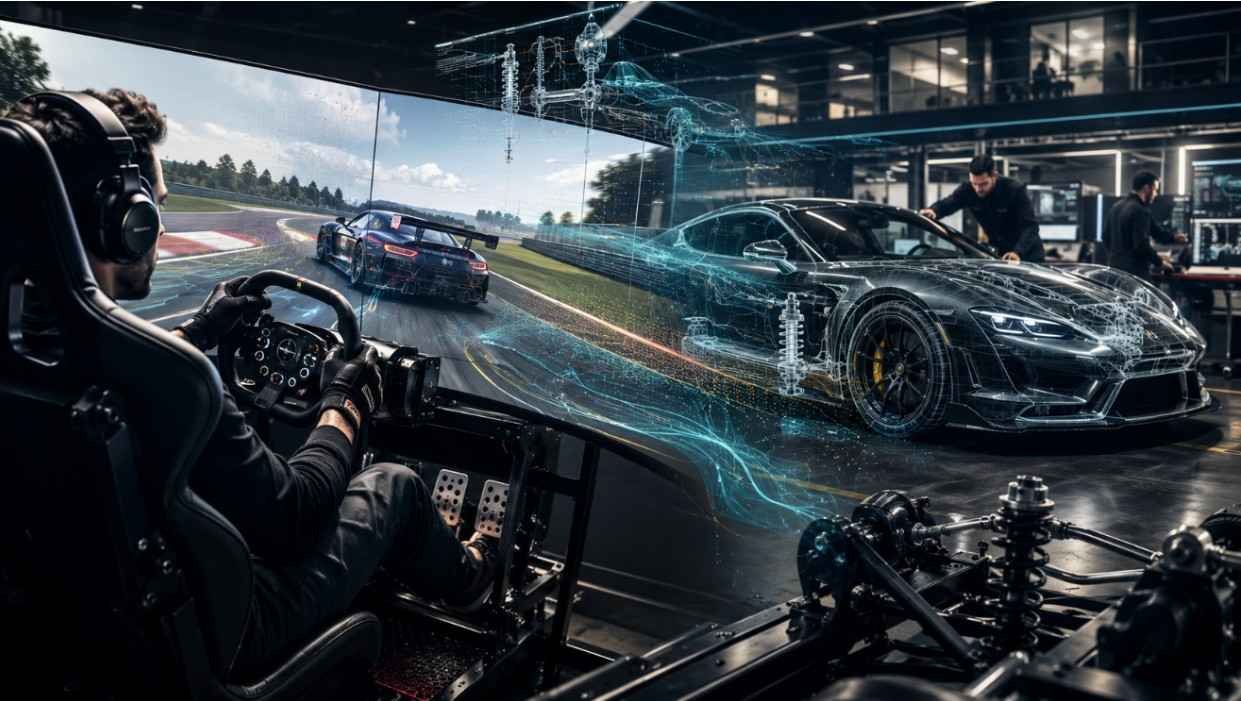
Instead of waiting for physical prototypes, teams can iterate rapidly on digital twins of vehicles, adjusting parameters in real time and immediately observing the effects on performance and stability.
This dramatically reduces development time while increasing the precision of tuning decisions.
The Rise of the “Digital Twin” Vehicle
One of the most important concepts in modern automotive engineering is the digital twin—a virtual replica of a physical vehicle that behaves according to real-world physics data.
These digital twins are not static models. They evolve alongside the physical car throughout its development lifecycle. As more data is collected from real-world testing, the simulation becomes more accurate. In turn, improvements made in simulation can be transferred back into physical prototypes.
This feedback loop is redefining how vehicles are engineered.
Instead of relying primarily on late-stage physical testing, manufacturers can now explore thousands of virtual iterations before a single production part is finalised.
The result is not just efficiency, but a fundamentally different approach to problem-solving in vehicle dynamics.
Motorsports as a Testing Ground for Simulation
Motorsport has played a crucial role in bridging simulation and real-world performance.
Formula One teams, endurance racing engineers, and high-performance development divisions have long used simulators to train drivers and test setup changes before track sessions. What has changed in recent years is the level of accuracy and trust placed in these systems.
Drivers now regularly use simulators that replicate not only the physics of the car but also specific circuits, tyre wear conditions, and even weather transitions. In many cases, simulator data is used to inform race strategy and car setup decisions.
The crossover between virtual and real-world performance has become so tight that discrepancies between simulator and track data are often treated as engineering problems to be solved, rather than limitations of the system.
This has created a feedback loop where real-world driving improves simulation accuracy, and simulation insights directly influence real-world outcomes.
Gaming Technology and Engineering Convergence
Interestingly, some of the most significant advances in simulation technology have origins in the gaming industry.
High-end racing simulators used by engineers and professional drivers share underlying technologies with consumer racing games: physics engines, force feedback systems, motion tracking, and graphical rendering pipelines.
While consumer games prioritise accessibility and entertainment, their underlying simulation frameworks have pushed hardware and software development forward in ways that benefit engineering applications.
At the same time, professional simulators demand extreme accuracy in tyre modelling, suspension response, and aerodynamics—areas where engineering requirements go far beyond entertainment.
The convergence of these two domains has accelerated innovation on both sides.
How Simulation Is Changing Vehicle Safety
Beyond performance and tuning, simulation is also transforming automotive safety development.
Crash avoidance systems, emergency braking algorithms, and stability control features can all be tested under thousands of simulated scenarios that would be impractical or dangerous to replicate physically.
Engineers can simulate edge cases such as sudden pedestrian movement, unpredictable road surfaces, or extreme weather conditions. These simulations help refine software responses long before they are deployed in real vehicles.
This approach allows manufacturers to explore rare but critical scenarios with far greater depth than traditional testing methods would allow.
In practice, this means modern safety systems are increasingly shaped by virtual environments as much as physical ones.
The Human Element in a Simulated World
Despite the sophistication of modern simulators, human input remains essential. Professional test drivers and engineers provide feedback that no algorithm can fully replicate.
Subtle sensations—steering feel, weight transfer, brake modulation, and perceived stability—still require human interpretation. These subjective insights are then mapped back into simulation parameters to improve accuracy.
This interplay between human experience and computational modelling is one of the defining characteristics of modern automotive development.
It ensures that even as cars become more software-driven, they remain grounded in real-world driving sensation.
Broader Cultural Impact on Driving Identity
As simulation technology becomes more influential, it is also shaping how drivers perceive performance and control.
Younger enthusiasts, in particular, are increasingly familiar with driving dynamics through simulation before they ever experience them in real life. This creates a new baseline understanding of vehicle behaviour that influences expectations of steering response, handling balance, and performance feedback.
In a broader cultural sense, driving is becoming more analytically understood. Terms once confined to engineering discussions are now part of mainstream enthusiast language, partly due to exposure through simulation platforms.
Even elements of vehicle identity and presentation sit within this evolving ecosystem of digital and physical convergence. Within the wider automotive landscape, companies such as Plates Express exist as part of how drivers continue to express identity in a world where much of the driving experience is increasingly shaped by software and simulation.
Conclusion
The future of driving physics is no longer confined to test tracks and physical prototypes. It now exists in parallel digital environments where vehicles can be built, broken, refined, and reimagined countless times before they ever touch asphalt.
Simulation has moved from the periphery of automotive development to its centre, reshaping how cars are engineered, how safety is validated, and how performance is understood.
As these systems continue to evolve, the boundary between virtual and real driving will continue to narrow. What remains constant is the goal: to make vehicles safer, more predictable, and more engaging—whether their physics are experienced on a screen or on the open road.